The evolution of technology has moved us from rule-based systems—where marketers manually set up "if-this-then-that" logic—to AI-driven personalization. This shift allows for real-time, automated decision-making at a scale that was previously impossible. For Magento merchants, this means the ability to serve unique experiences to millions of visitors simultaneously without increasing administrative overhead.
This guide is designed to provide a practical roadmap for implementing AI-driven personalization in Magento. We will explore the technical foundations, the most impactful use cases, and the step-by-step process of transitioning your store from a static catalog to a dynamic, intelligent commerce engine.
At its core, personalization in a Magento context refers to the use of machine learning algorithms to dynamically alter the content, product recommendations, and search results a user sees based on their individual behavior. Unlike traditional personalization, which relies on static customer segments (e.g., "all users from New York"), AI looks at high-dimensional data points to create a "segment of one."
The primary difference lies in the logic. Traditional personalization is deterministic; a human must decide that "users who bought a camera should see a tripod." AI-driven personalization is probabilistic. It analyzes massive datasets to discover that users who bought a specific camera, visited the site twice on a mobile device, and searched for "vlogging" are 85% more likely to buy a specific microphone. This predictive nature allows the store to feel intuitive, often presenting the customer with what they need before they have to search for it.
To achieve this, AI uses three main types of data:
The business case for integrating artificial intelligence into your Magento store is rooted in measurable financial outcomes. Merchants who successfully implement these strategies typically see a significant lift in conversion rates and AOV. When a customer is presented with products they actually want, the friction to purchase decreases, and the likelihood of adding complementary items increases.
Beyond the immediate transaction, AI-driven strategies are a powerful driver of customer retention. By consistently providing relevant experiences, a brand builds trust and emotional loyalty. Shoppers are more likely to return to a store that "knows" them, reducing the long-term reliance on expensive customer acquisition through paid channels. In an era where the cost per click (CPC) is constantly rising, the ability to maximize the value of every existing visitor is the key to sustainable profitability.
Furthermore, AI personalization delivers the highest ROI when it solves the problem of "catalog paralysis." For stores with thousands of SKUs, finding the right product can be overwhelming. AI acts as a digital concierge, filtering the noise and presenting only the most relevant options. This is particularly critical for mobile users who have limited screen real estate and less patience for complex navigation or deep-drilling filter menus.
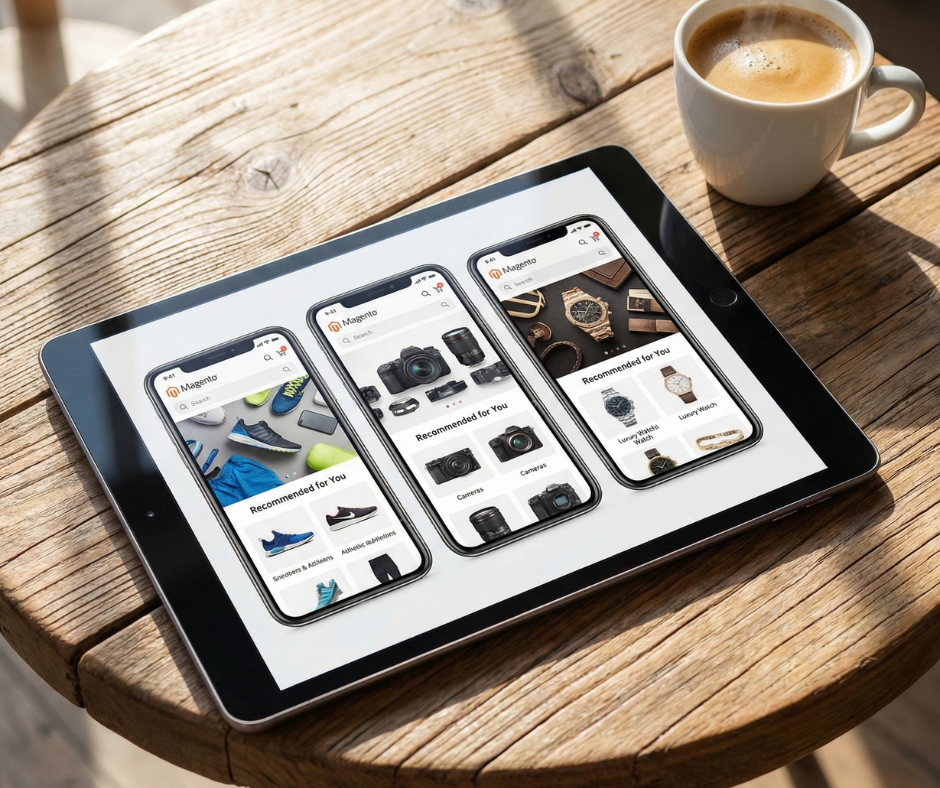
When beginning your journey, it is essential to focus on the use cases that provide the most immediate value and have the lowest barrier to entry.
This is often the entry point for most merchants. Using tools like Adobe Sensei (for Adobe Commerce) or third-party extensions, you can deploy various recommendation types across the store. AI can analyze visual similarities or behavioral patterns to suggest "Shop the Look" bundles or "You May Also Like" items. Placements should be strategic—use the homepage for discovery, the Product Detail Page (PDP) for upselling to higher-margin items, and the cart page for cross-selling impulse buys like accessories or protection plans.
Search is often the highest-intent action a user takes. AI-driven search relevance ensures that if two different users search for "jacket," the results are sorted based on their individual style preferences, previous brand affinity, or gender. Dynamic filters and category ordering also play a role; AI can reorder category pages so that the products most likely to appeal to the specific visitor appear at the top of the grid, significantly reducing the "time to cart."
Personalization extends to the banners and messaging a user sees. A returning VIP customer should see a "Welcome Back" hero banner with a loyalty reward, while a first-time visitor might see a generic brand story and a newsletter sign-up incentive. Behavior-based offers can also be triggered—for instance, providing a limited-time free shipping offer only to users who have visited the shipping policy page multiple times in one session without adding to the cart, indicating they are on the fence due to delivery costs.
AI replaces static, manual segments with predictive modeling. Instead of just knowing who has bought in the past, AI can predict who is likely to churn or who is most likely to respond to a high-ticket luxury item. This allows marketing teams to allocate their budget more effectively by targeting high-value "lookalike" audiences and sending personalized email sequences that arrive exactly when the customer is predicted to be ready for their next purchase.
Before installing any software or configuring complex algorithms, you must evaluate your foundation. AI is only as good as the data it consumes, and launching on a shaky foundation can lead to inaccurate recommendations that frustrate users.
First, evaluate data availability and quality. Does your Magento instance correctly track basic events? Are your product attributes clean and consistent? If your "color" attribute is sometimes "Navy" and sometimes "Dark Blue," an AI model will struggle to recognize the pattern. Part of this audit involves preparing your Magento B2B store for AI trends to ensure that your infrastructure can handle the real-time processing requirements and data syncing protocols needed for modern machine learning.
Second, consider traffic and conversion thresholds. Most AI models require a "warm-up" period where they observe user behavior to build accuracy. If your store has very low traffic (less than 10,000 visitors per month), the AI may not have enough data to provide meaningful insights, and simple rule-based systems might be more appropriate until you scale.
Finally, consider technical and operational readiness. Does your team have the capacity to monitor the AI's performance? Do you have the necessary consent management layers in place to track user behavior legally? These operational questions are just as important as the technical ones.
Magento offers three primary paths for implementation, depending on your budget, version, and technical resources.
The first is native Adobe Commerce capabilities. If you are using the cloud-based Adobe Commerce, you have access to Adobe Sensei-powered Product Recommendations and Live Search. These are deeply integrated, highly scalable, and require minimal custom code. They use Adobe’s global data pool to help "jumpstart" recommendations even for new stores.
The second path is third-party AI personalization platforms (such as Nosto, Klevu, Clerk.io, or Algolia). These platforms often offer a broader suite of tools across search, email, and web. They typically work by injecting a JavaScript snippet and syncing your catalog via a feed or API. The advantage here is that these tools are platform-agnostic, meaning if you ever move away from Magento, you can take your "trained" AI with you.
The third path is the "build vs. extend" framework. While rare for small to mid-sized merchants, enterprise-level brands may choose to build custom machine learning models using AWS Forecast or Google Cloud AI and connect them to Magento via custom modules. For 95% of merchants, the "Buy" or "Extend" approach using existing platforms is the more cost-effective and faster route to market.
Execution requires a methodical approach to data and design. Implementation of AI-driven personalization in Magento should follow a phased rollout to minimize risk and allow for data gathering.
Data integration and tracking setup
The first technical task is setting up behavioral tracking. This involves placing "event listeners" on your site to track views, cart adds, and purchases. This data is usually sent to the AI engine via a Data Layer. You must also ensure a clean, real-time sync of your product catalog, including inventory levels, images, prices, and complex attributes. If the AI recommends a product that is out of stock because the sync is delayed, you lose customer trust.
Configure personalization scenarios
Once data is flowing, you can set up your logic. Start with one or two high-impact areas, such as the PDP recommendations. Define your logic: will you prioritize "More Like This" (visual similarity) or "Others Also Viewed" (behavioral similarity)? For email, set up trigger-based personalization, such as an automated "We thought you might like this" email sent 24 hours after a user browses a specific category but doesn't make a purchase.
UX and design considerations
Personalization should be subtle and helpful, not intrusive. Avoid the "uncanny valley" where the AI knows too much, which can feel "creepy" to users. For example, avoid saying "We know you are in London right now"; instead, simply show products that are popular in London. Ensure that personalized blocks match your site's design aesthetic perfectly—if the recommendation block looks like an ad, users will ignore it. Furthermore, prioritize mobile-first personalization. On a small screen, the AI's ability to show the "right" product first is even more valuable than on a desktop.
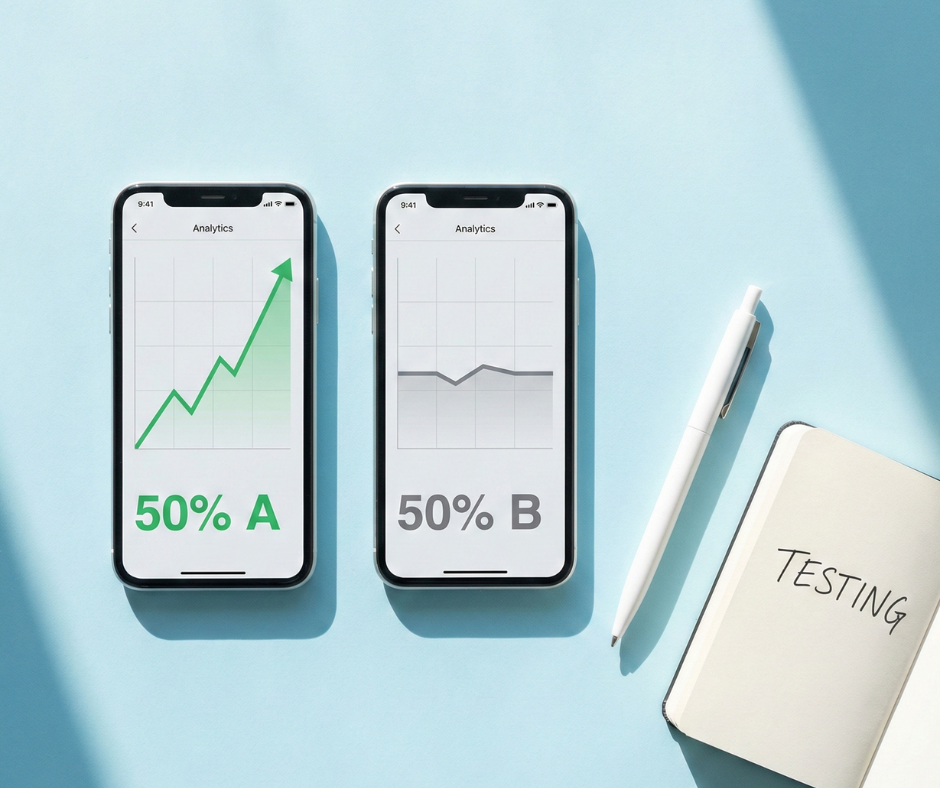
You cannot manage what you do not measure. A/B testing is the only way to prove the "lift" generated by AI.
Set up an experiment where 50% of your users see the AI-driven recommendations and 50% see the default Magento-related products (which are usually set manually). Track key metrics:
Common pitfalls include ending tests too early or failing to account for seasonality. A personalization strategy that works during the Christmas holiday might not be as effective in the "quiet" months of February. Always allow at least two full business cycles (usually two to four weeks) before making final decisions based on test data.
Once you have mastered the basics on the storefront, expand the reach of the AI across the entire lifecycle.
In the pre-purchase phase, use AI to personalize landing pages for users coming from specific ad campaigns. If a user clicks an ad for "running shoes," every banner they see on the site should reflect that intent until they purchase or their behavior changes. During the session, use "in-session" personalization to adjust the navigation menu in real-time.
In the post-purchase phase, use personalization for retention. Use the customer’s purchase data to send replenishment reminders or educational content. If they bought a complex espresso machine, send them a personalized video guide on how to clean it. This builds a relationship that goes beyond a single transaction and turns a one-time buyer into a brand advocate.
Even with the best technology, execution can fail if not managed properly.
One major mistake is over-personalization and UX overload. If every inch of your page is a "personalized block," the site becomes cluttered and confusing. Another risk is poor data quality; if you feed the AI bad data (like incorrect stock levels), it will recommend products that are out of stock, leading to customer frustration.
Do not rely on AI without human oversight. AI is a tool for the marketer, not a replacement. You must still define the brand's guardrails. For example, you might want to prevent the AI from recommending clearance items on the PDP of a new, high-margin product launch. Lastly, ignoring privacy and compliance can lead to legal issues. Always be transparent about how you use data and ensure your "Terms of Service" clearly explain the use of cookies and behavioral tracking.
To ensure longevity, start simple. Implement product recommendations on the PDP first, gather data, and then move to more complex search or category reordering. Always align your personalization efforts with your business goals—if your goal is to clear old inventory, tune your AI to prioritize those items in certain "trending" blocks while maintaining a high relevance score.
Continuous testing is the hallmark of a successful merchant. The digital market changes rapidly, and your AI models must be periodically reviewed and retuned to account for shifts in consumer behavior. Finally, foster cross-team collaboration. Personalization is not just a "tech" project; it requires input from marketing (for messaging), CX (for journey mapping), and the technical team (for integration).
AI-driven personalization in Magento is the bridge between a functional store and a world-class shopping experience. By moving away from rigid, manual rules and embracing the fluid, predictive power of machine learning, merchants can meet the high expectations of the modern consumer.
The implementation roadmap is a journey of continuous refinement. It begins with a solid data foundation, moves through strategic use cases like recommendations and search, and scales into a fully personalized customer journey. Remember that AI personalization is a long-term capability, not a one-time setup. The more data the system gathers, the more intelligent—and profitable—it becomes.
In the competitive world of Magento commerce, relevance is the ultimate driver of revenue. By making every customer feel like your store was built specifically for them, you turn simple visits into transactions and transactions into lifelong brand loyalty. Apply these principles systematically, and your Magento store will be well-positioned to thrive in the era of intelligent commerce.
.png)

